Product designer who builds. Six years designing at Bajaj Finserv, and the evenings making whatever I need next. Everything here is shipped, live, or in someone's hands.
We started as three new designers no one listened to. I tied our design work to data, one framework at a time, eight in all.
Six case studiesMore work below ↓
Me and AI
From using it to building with it, then building the system it runs on.
01Using it
02Building with it
03Building the system
ChatGPT, like everyone
Context first
A server, by hand
Software for one
Claude Code
Teaching others
Tools to share
A second brain
One system
It pays off
1Mac · ChatGPT
2·8context · memory
3home server
4·7tools
5Claude Code · skills
6workshops · Roadmap
9·10shipped
More work
Also made
Fantasy Calradia
A mod that remakes the game Bannerlord as a fantasy world: nine peoples, 1,552 voice lines and 26 music pieces. Trending on Nexus's front page for three days; 1,549 downloads and 2,700 trailer views.
A Bluetooth shortcut keypad with a case modelled in code, my own firmware and hand-soldered wiring. Version two came from a week of notes on version one.
HardwareOn my desk
Maanak
Accessibility audits for Figma components against WCAG and Indian standards, as a skill and a plugin.
A trading agent that works within hard risk limits. Researched, scoped and built in stages; still trading with simulated money.
AICodePrivate
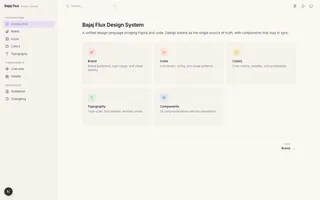
Bajaj Design Library2022 → now
Components written for two readers: designers and AI. The rules came from years in Figma, and from teaching AI to turn Figma into code.
2
libraries, one shared framework
~600
components in the everyday library
204 · 902
components and variants in the AI-platform library
Open the case study →
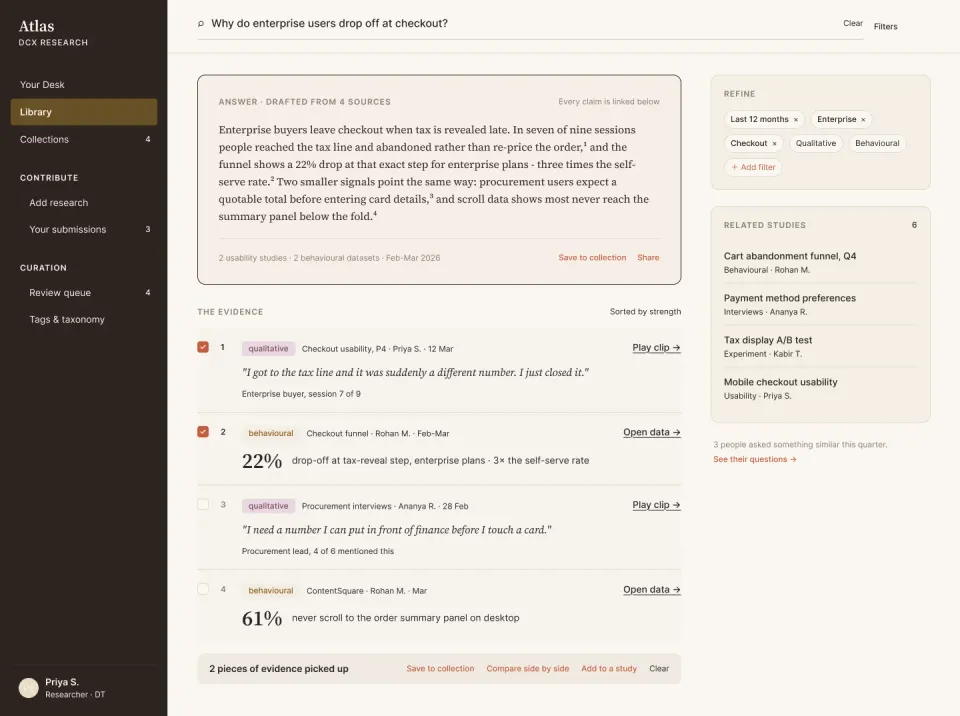
DCX Atlas2026
Bajaj's research used to end with each project. I pitched a place where it stays findable, and once leadership agreed, I designed and built it.
Pitched
to leadership, and approved
End to end
designed and built by me
30 insights
from a 55,000-character study, in about two minutes
Open the case study →
Bajaj's AI-first platform2024–26
I helped Bajaj Finserv's leadership commit to an AI-first platform. Two pieces of it shipped before the platform was built.
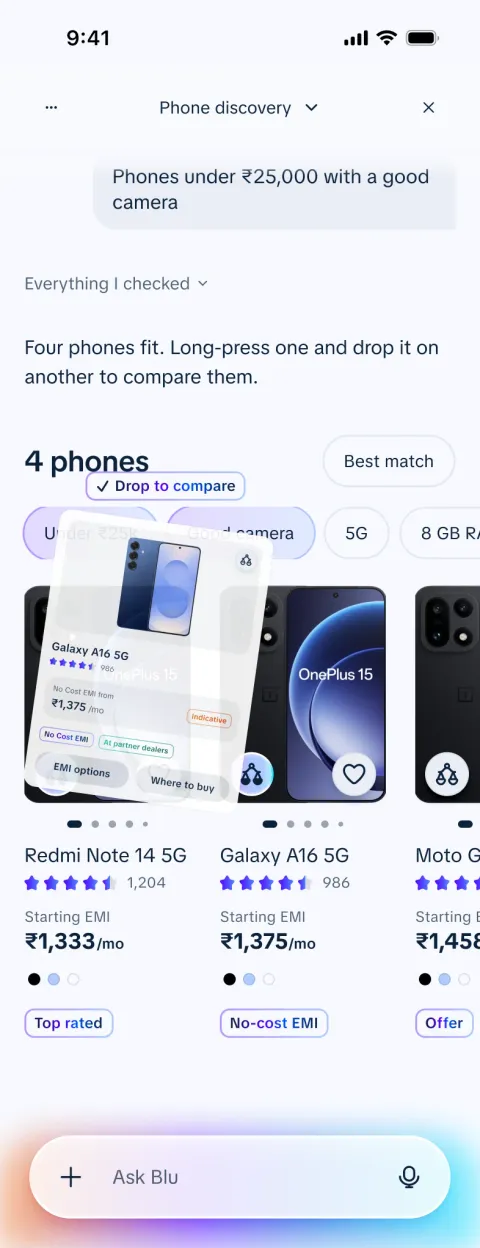
Blu
Bajaj's AI chatbot, upgraded and live on every product
Website AI
live on bajajfinserv.in
Led
the idea, key parts and the groundwork
Open the case study →
BFL Website Redesign2021–25
Four years, six products. I found the steps where people dropped out of each journey, and fixed them alongside the visual refresh.
+21.6%
conversion
24.3M
visits a month
6 · 24
products and journeys, with a team of three
Open the case study →
Pencil Down2026
A trainer for CEED, India's design entrance exam, that drills exam temperament: see the question, decide, commit, move on.
1,494
real questions from 49 past papers
11
puzzle generators whose answers can't be wrong
< 1 day
from research to live
Open the case study →
Building the DCX team2021 → now
We started as three new designers no one listened to. I tied our design work to data, one framework at a time, eight in all.
Founding member
of DCX (Digital Customer Experience), BFL's design team
8
frameworks connecting design and data
Open the case study →
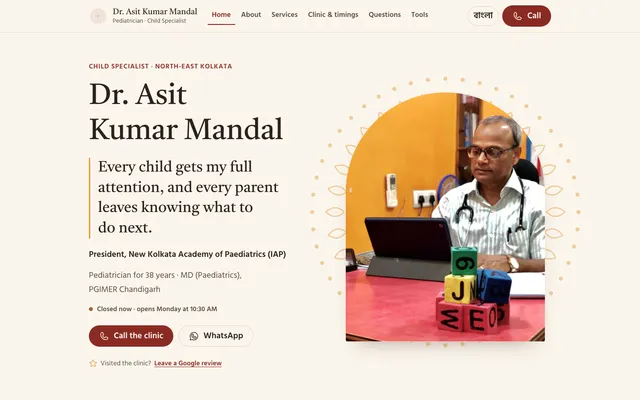
ShishuDr. Asit Kumar Mandal
My father's practice, online: one set of facts behind a bilingual website and every listing a parent might find.
My father has practised as a paediatrician in North-East Kolkata for 38 years. Online, the practice was in disarray: unclaimed directory pages that contradicted each other, and another company's booking link attached to his Google profile.
I didn't start with a website. I started with a single file of facts, and made everything else read from it.
The site
In English and Bengali. The site won't publish if the two languages don't match.
Tools parents actually use. A vaccination chart and a milestones checklist, with each child's details kept on the parent's phone.
Live in a day. From the first line of code to public and searchable, on my own server and domain.
Every listing, one source
The same facts everywhere. Google Business Profile, Search Console and five directories all carry the same name, hours and credentials.
Reviews through a link I control. So the QR codes printed in the clinic never need replacing.
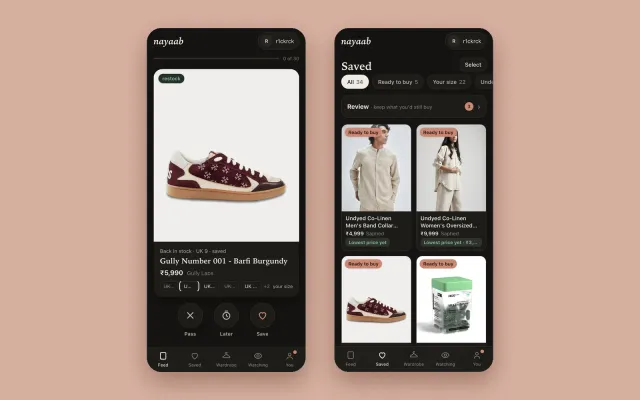
A birthday gift: a shopping scout that watches the small labels she loves and learns her taste.
She shops from small, independent studios: handloom, block print, one-person labels. Marketplaces don't stock them, the best pieces sell out quickly, and keeping up meant checking dozens of sites by hand. So for her birthday, I built nayaab.
What it does
It can read any shop. Paste a shop, a brand, an Instagram handle or a product link. Common platforms are read directly; for the rest, AI works out how to read the shop once, and an automated browser repeats it.
From Instagram post to product page. Share a post, and it finds the shop and the exact listing.
It works in the background. It checks each shop every 5 to 60 minutes, and a daily run at 6:30 ranks the finds, updates her taste and looks for new labels.
Alerts only when they matter. A restock in her size, a price drop, or a new drop from a shop she's marked urgent. Quiet hours are respected.
A feed that ends. Thirty finds a day. Refreshing never adds more.
Saved items lead to a decision. Each is flagged when it's ready to buy or at its lowest price yet, and she's regularly asked if she'd still buy it.
Taste she can read and edit. Her preferences live in a plain file. nayaab suggests changes; she approves each one.
Exploration on a dial. New small brands that fit, plus a few deliberate stretches, as adventurous as she chooses.
It knows her wardrobe. Photograph what she owns, and the feed hides it and flags near-duplicates.
How it's built
AI only where judgement is needed. Plain code fetches, ranks and alerts. AI never writes to the database.
About $0.43 a day in AI costs, for its two users.
Live in a day, finished in five days and 44 commits.
DesignCodeAI
Comfy Studio
An image and video studio shared across a Mac and a PC, built to run as reliably as a product.
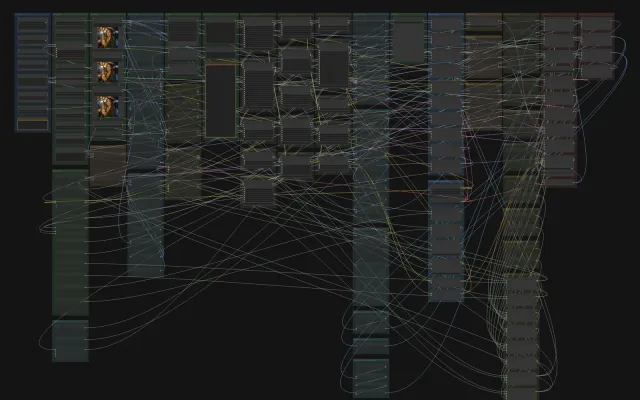
Built on ComfyUI, where image tools are wired together as a graph. I designed mine so every feature is a switch, never a rewire.
What the workflows can do
Create, edit, remix. From a prompt, from an instruction, or by redrawing over an image.
Paint to change. Edit only a painted area and leave every other pixel untouched.
Guide with references. Up to five images to steer a result.
New camera angles on the same subject.
Layers. Split a character into transparent layers in depth order, or export transparent PNGs.
Styles. Style add-ons (LoRAs) stacked for different looks, all off by default.
Speed or quality, with a single switch.
Upscale, then animate. Sharper finals, and stills turned into looping video and sprite sheets.
A front panel, not a node graph
Every control on one screen, in the order you use them.
Fields say when they apply, with help behind an ⓘ.
The engine stays collapsed, so I never have to trace the graph to make an image.
Built by scripts, tested in full. All 216 switch combinations in the main workflow were checked to run exactly as intended.
Custom nodes
Fresh randomness for every edit, so an edited image never repeats the original's pattern.
A face mask drawn from 28 points it finds on the face.
Memory clean-up that frees the graphics card between video passes.
What I fixed
Images coming out black on the Mac, traced to the cause and fixed.
Patches on the PC so it finds its models and style strength can be set.
Two machines, one studio, kept in sync, each saving only to its own folder.
AICode
roster + homelab desk
Agents that know about each other, and a desk on my server that takes work from any device.
devicesagents
→
homelab-deskassigns
→
workerruns it
I run several AI agents at once, on one folder and one server. They need what a team needs: to know who is changing what.
roster
Every agent gets a card: what it changed, what it's using (a build, a deploy), and when its person last typed.
Check before interrupting. Agents read each other's cards before sending a message.
No one is locked out. An agent can choose to wait while another finishes with what it needs.
homelab desk
One way into the server. Agents on my other devices send work to homelab-desk, an agent that lives there.
Workers on demand. The desk starts one per job, up to three at once, and closes them when idle.
Deploying is a push. My server builds the code and puts it live at its own address on nesh.studio, my server's domain. nayaab shipped this way.
roster is open source and installs as a Claude Code plugin.
An exhaust filter for the H2D, my 3D printer: designed in code, printed, fitted and working.
My printer sits in my bedroom. The filter cut the fumes reaching the room from 100% to under 10%.
Designed in code
Modelled in code-CAD, my setup for describing 3D parts in code instead of drawing them.
Three parts: a hood over the printer's rear vent, a pipe and a charcoal filter, sealed with flexible gaskets.
Measured before modelled
The vent is 133 mm wide, measured with calipers; the figure shared online was off.
Every fit checked before printing: all nine places where parts meet, tested in the model so nothing overlaps.
Fixed when it failed
The first hood split. I rebuilt it as two pieces that lock together with a stepped joint, keeping the opening the same size so it still fit.
Reprinted, and running ever since.
HardwareCode
Research Agents
Eight AI stand-ins for our customers, built from interviews and analytics. Hand them a screen and they test it.
A way for Bajaj's design team to test a concept before real customers see it, without pretending a model is a person.
Who they are
Eight personas, drawn from our customers: 32 interviews, 5 recorded sessions and Google Analytics data on who actually visits.
Twelve research papers shaped them: how an AI persona can genuinely take a test, and where simulated users tend to fail.
How a test runs
A researcher submits a screen. A lead agent runs the test (usability, first click, concept or interview) with all eight at once.
They see only what a customer would see, a screenshot, never the code behind it.
They talk like our customers, in Hinglish, the mix of Hindi and English most of them use.
Then each steps out of character to explain why it did what it did, so the team can check its reasoning.
What comes back
A missed tap stays a missed tap. The report records every stumble as it happened.
Fixes, not vetoes. The report suggests what to change in the design; it never tells the team not to ship.
First real run: a concept for Bajaj's AI platform. All eight said the same: not ready yet, keep iterating.
Next: the same test, run by people and by agents side by side.
DesignAI
DTPI
Design thinking, written for the leaders of a finance company rather than its designers.
Design adoption in finance is weak, so DTPI wasn't written for designers. It was written for the company's leaders, from the leadership team through to middle management, to give them a way of thinking and the tools to practise it.
Design is a process before it is a set of screens. DTPI put that process in front of the people who make the decisions.
The framework
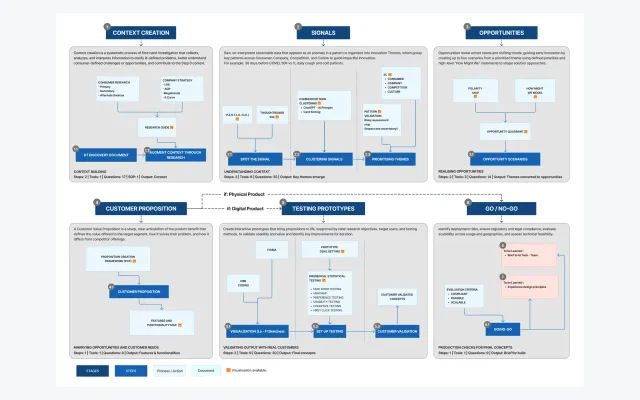
Six stages, from context to go / no-go: context, signals, opportunities, customer proposition, prototype testing and the final call.
A tool and questions for every step, 113 guiding questions in all, with a clear output at the end of each stage.
Two routes. Digital products go through prototype testing; physical products go straight to the go / no-go.
AI built in. Prompts that group signals into themes; AI coding tools and Figma for prototypes.
Adapted from IDEO, the Royal College of Art and India's National Institute of Design for a company of 65,000 people.
Why it won
Reach. Leadership workshops ran on it and produced the four opportunity areas that shaped CAI.
HEROES award, October 2025, for that success and reach.
In next year's plan, with its roll-out written into Bajaj's FY27 operating plan.