An AI-first platform
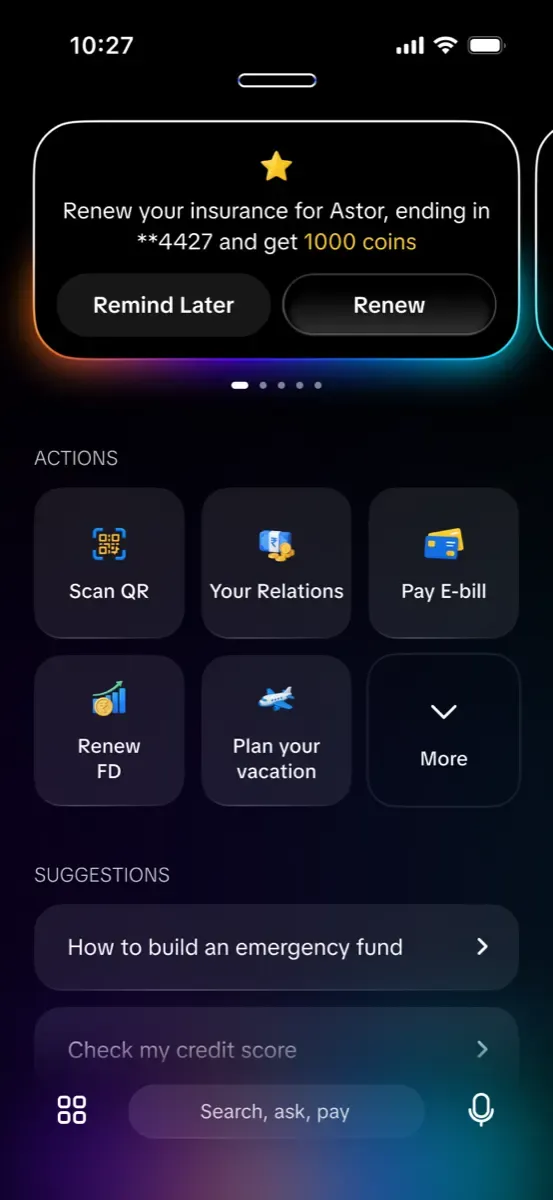
CAI, Bajaj's AI-first platform, puts a financial butler in every customer's app. I helped leadership commit to it, and argued for the moments when tapping beats talking.
The idea
Late 2024 → Jun 2025A financial butler, not a chatbot.
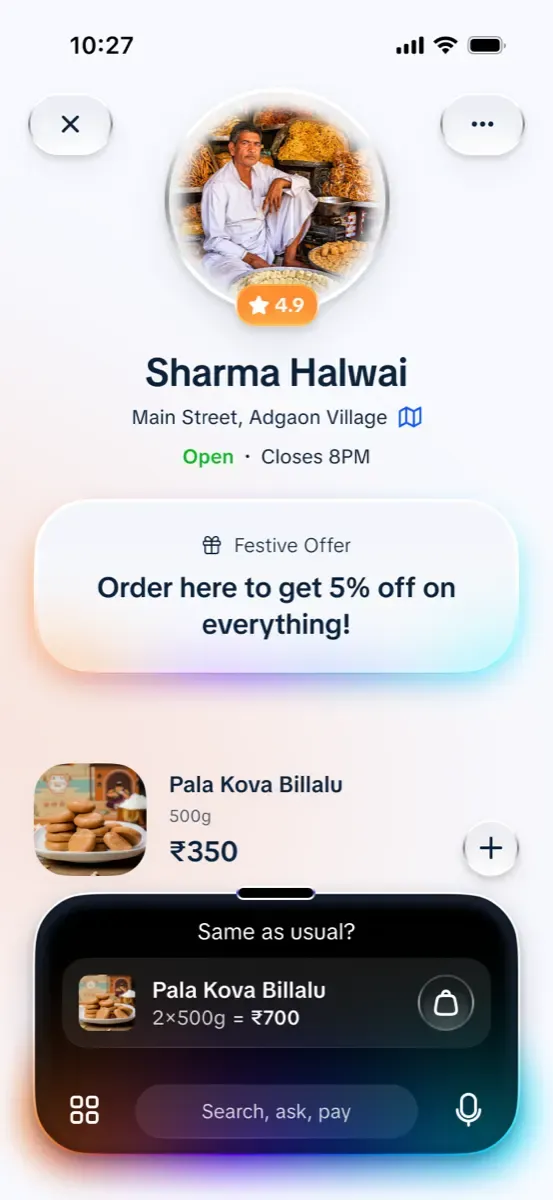
In workshops with leadership we settled the pitch: anyone who opens the app gets a butler for their money. It remembers, reminds and explains across loans, cards, insurance and savings. That makes it a platform: one AI layer over every Bajaj product.
It went into the long-range plan as "Pioneering AI" and became a project of its own.
From today to AI-first
- Rigid, templated page structuresFluid yet structured
- Fixed ecosystem mapsPatterns-based output
- For the next generationReal, now and for everyone
- Built from the company outBuilt from the consumer in
- Refresh every 4 yearsAlways in beta
The room
Sep → Oct 2025Leadership had to learn to think like designers.
A lending company plans from the business case. An AI-first platform can't be planned that way, so the first thing I designed was a way of deciding: DTPI, a design-thinking framework that later won Bajaj's HEROES award. We brought in IDEO; I sat on the panel that chose them. Their workshops with leadership turned the pitch into four opportunity areas.
- 01ContextWhere we stand
- 02SignalsKey themes emerge
- 03OpportunitiesThemes become opportunities
- 04PropositionFeatures and functions
- 05PrototypesCustomer-tested concepts
- 06Go / no-goA brief to build from
The tension
ThroughoutNot everything should be a conversation.
The hype pulled every step into chat. But typing or saying an answer the customer could tap is slower, and less certain. I kept arguing for direct manipulation, controls you touch inside the conversation, and wrote it into the system's rules.
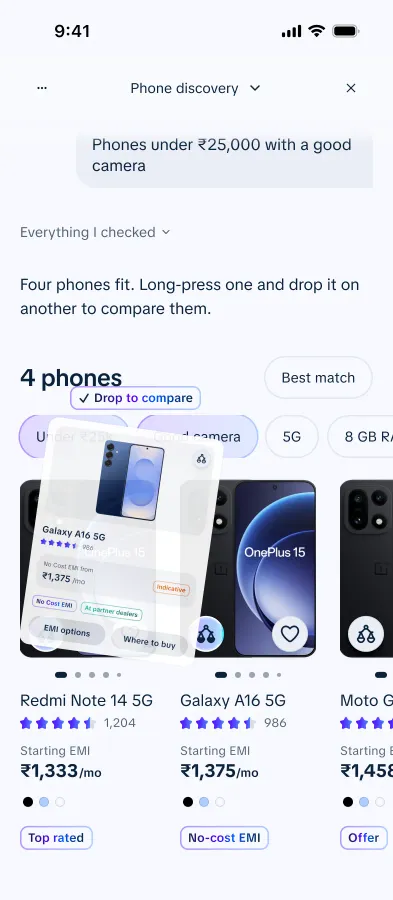
- Talk when it's faster to say."Phones under ₹25,000 with a good camera" beats six filters.
- Tap when there's a choice.One option is a question. Short answers are chips to tap. When a search returns two or three products, each gets a card with its picture and monthly EMI.
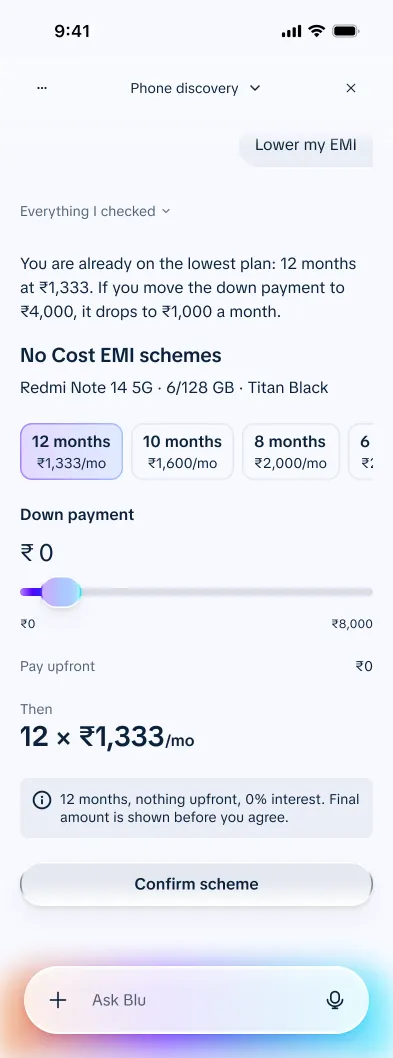
- See it before you commit.Money gets live controls: the EMI changes as you pick a plan or move the down payment.
- The customer owns the controls.A tap is the customer's answer. Blu suggests, and never moves a control for them.
The proofs
Oct 2025 → Mar 2026Every meeting ended with something leadership could touch.
We brought screens, motion, a coded prototype and videos of the principles. Research with 23 customers and 7 partners across 4 cities gave us the line we built on: guide the customer, and let them decide.
people brought into the work in 64 days, across 47 meetings, 4 workshops and 5 countries.
- Layered depth8
- Glow9
- Soft shadows8
- Depth shows priority8
- One thing in focus9
- Visual feedback for touch8
- Glow on what's tappable9
- Transition effects10
- How much fits on screen10
"If it pays automatically, I'll be scared."
A customer in the concept research. It changed what the butler was allowed to do.
What shipped
2025 → nowTwo pieces went live before the platform existed.
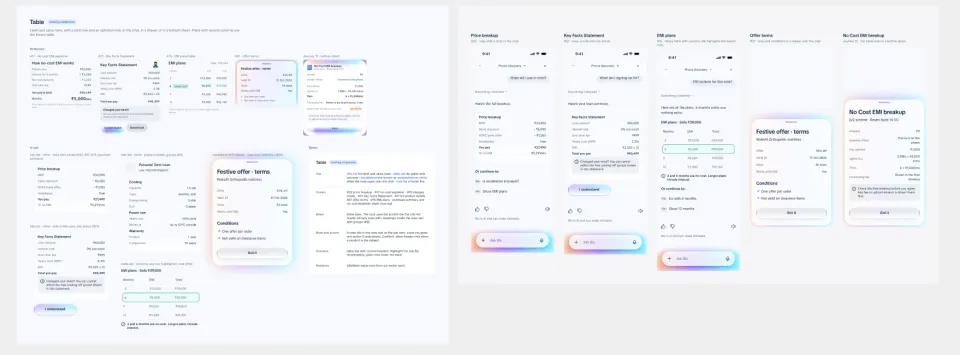
Blu, Bajaj's chatbot, got its upgrade: a loan journey that runs inside the chat, from eligibility to the offer. It's live on every product.
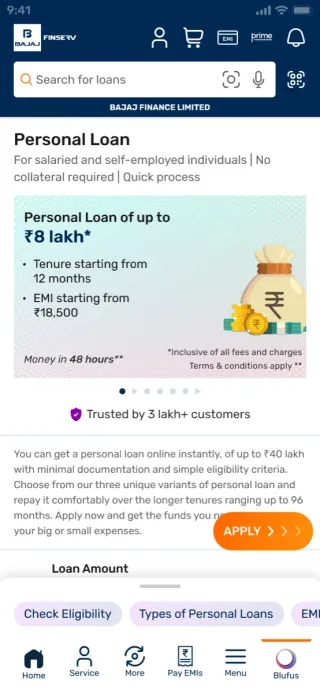
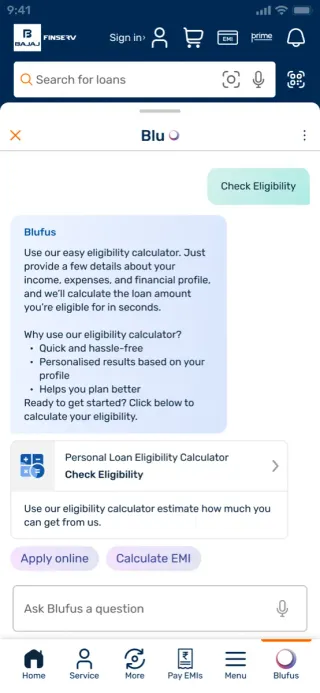
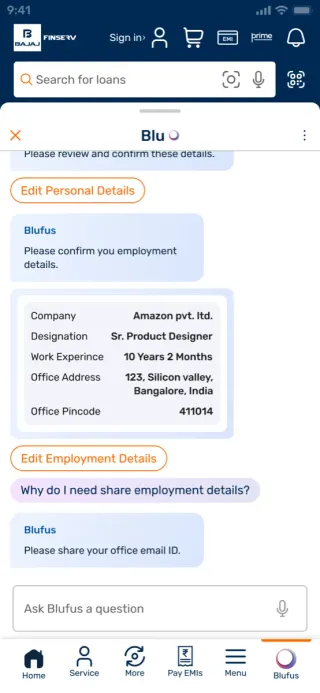

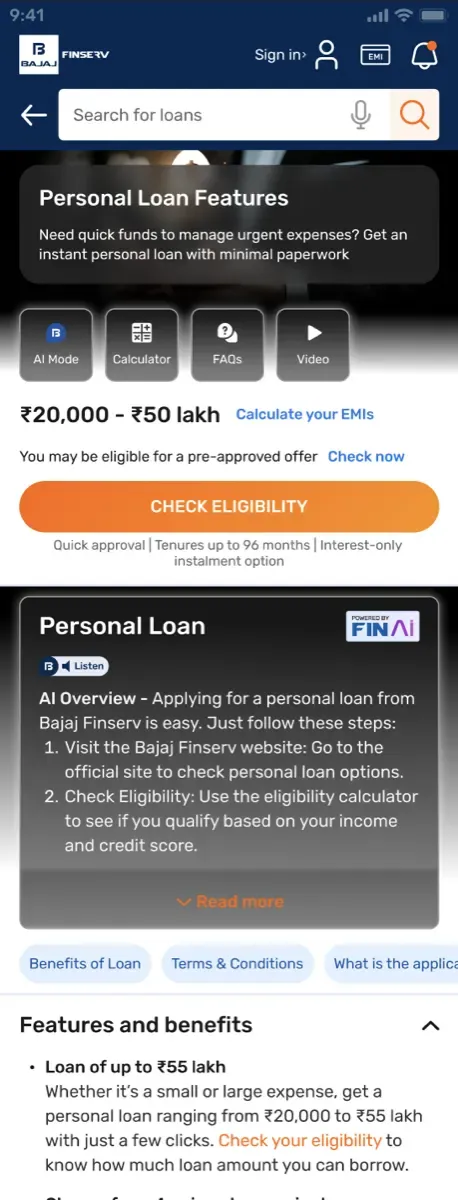
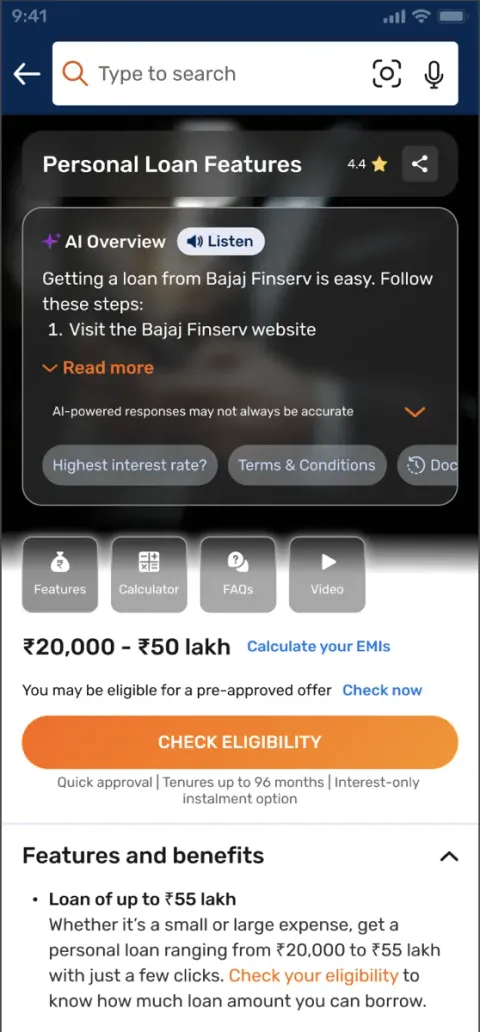
The live website got AI answers. 97% of testers found the summary helpful, but only 40% noticed it. So it moved to the top, and it writes itself in word by word, which marks it as AI.
The library
2026 → nowTapping and talking now live in one library.
The project began as Terranova and was renamed CAI. The CAI library, 204 components and 902 variants, follows the rules I set for the everyday library behind the live website, and gives every chat journey both kinds of part: things to say and things to tap. The library team delivered it in November 2026.
When ideas piled up, I gave the room a scoring rule.
The Critical Checklist, built in Figma Make, scores every idea against our principles. One critical "no" and it's out.
CAI principles91%
Critical7 checks5 yes · 0 no
Does the idea use only necessary data and make that visible to users at each step?
Can every claim or recommendation be traced to a source without overpromising?
Can users interact naturally, even with imperfect language, without learning commands or formats?
If the AI or system fails, does the idea provide a useful fallback and clear next steps?
Could this affect user groups differently, and is there a way to detect and fix that?
In regulated flows, does the idea apply consistent rules, keep an audit trail, and handle consent clearly?
Does it always show what happened, what is next, and how to continue without dead ends?
High6 checks4 yes · 1 no
Does it support multiple input/output modes and choose the right one for the user's context?
Can users choose the automation level and undo or review automated actions?
Does it explain why it made a suggestion with reasoning users can verify?
Can users view, edit, and clear memory, with session vs persistent memory clearly explained?
Does it use prior context to keep the experience continuous without making users repeat themselves?
Does it guide users to goals through intent-aware flows instead of fixed menus?
Medium5 checks2 yes · 0 no
Can users influence response tone, and does it stay consistent across contexts?
Does it adapt to user context and behavior in a visible, non-intrusive way?
Does it generate tailored outputs that users can refine?
Does it stay in the background and let users take over without losing context?
Does it coordinate multiple tools into one coherent flow without exposing unnecessary complexity?
Usability checks89%
Critical5 checks4 yes · 1 no
Can a first-time user with no specialized knowledge complete the core task without support?
Before submission, can users see the future impact of this decision?
Does AI reduce effort without taking away user control?
If something goes wrong, can users recover quickly without losing progress or context?
Are compliance, consent, and disclosures handled clearly in the flow?
High4 checks4 yes · 0 no
Is this usable for the target demographic across literacy, language comfort, ability, and device limits?
Does this feature address a real and immediate user problem, and is the value clear within seconds?
Can users understand and verify why a recommendation was made?
Does it carry context across products to reduce financial fragmentation?
Medium1 check1 yes · 0 no
Is this encountered naturally in existing financial workflows?
Also in this work
A design-thinking framework for all 65,000 people at Bajaj Finserv. It won a HEROES award.
Award · Oct 2025Each tied to the feeling it should create, from "I trust this advice" to "I am the boss".
18 principles · 67 guidelinesA design agency's app for the project, rebuilt as a working prototype: the AI answers with screens, not text, choosing from 87 component types.
Expo + React Native171 chatbot users: 89% had felt the chat was scripted, 41% said their need didn't fit any preset button.
Survey