Score only what's honest.
- Chose
- Seconds to commit, number of ideas, and whether each idea obeys the rules.
- Gave up
- An AI critic of the drawing.
- Because
- CEED pays for ideas. A critic of line quality pulls practice toward polish.
A trainer for CEED, a design entrance exam, that drills deciding on a clock you can't see. See it, decide, commit, move on.
CEED is the entrance exam for a master's in design at the IITs. Part A, the objective paper, is only a gate. Part B, the drawing paper, carries 75% of the score and is marked on ideas, not polish.
Marks leak in the same places: rereading a figure, guessing on a multiple-select question, four minutes on one puzzle, redrawing a first idea. Someone preparing for CEED doesn't need more questions. They need to practise deciding.
My own research pointed to an AI critic that grades photos of Part B sketches. I left it out. The app runs no AI and grades no drawings; it trains the decision.
Hard mode is the default. Each Part A question gets a budget you can't see: 60 seconds for single-choice, 90 for multiple-select, 120 for numerical. At zero the answer is saved as it stands and the question goes to a revisit list.
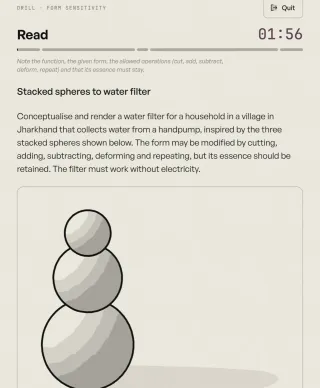
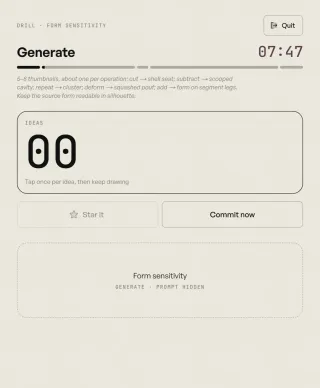
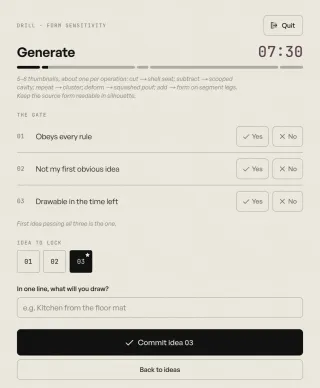
Part B shows the prompt for two minutes, then hides it, so you draw from memory. An idea passes three checks before you commit it: it obeys every rule, it isn't your first obvious idea, and you can draw it in the time left.
Learning to trust your first call only works if the key is right. Every answer shows its source: official key, worked out, or generated. A solved answer is never promoted to official.
Where an answer was in doubt, I ruled on each one: 4 of my worked answers corrected, 6 questions with no single fair answer dropped, 11 with a contested official key kept out of practice. A worked explanation ships only if it reaches the official answer.
Real questions from 49 past papers of CEED and UCEED, its undergraduate twin, 2010 to 2026, each one solved and checked.
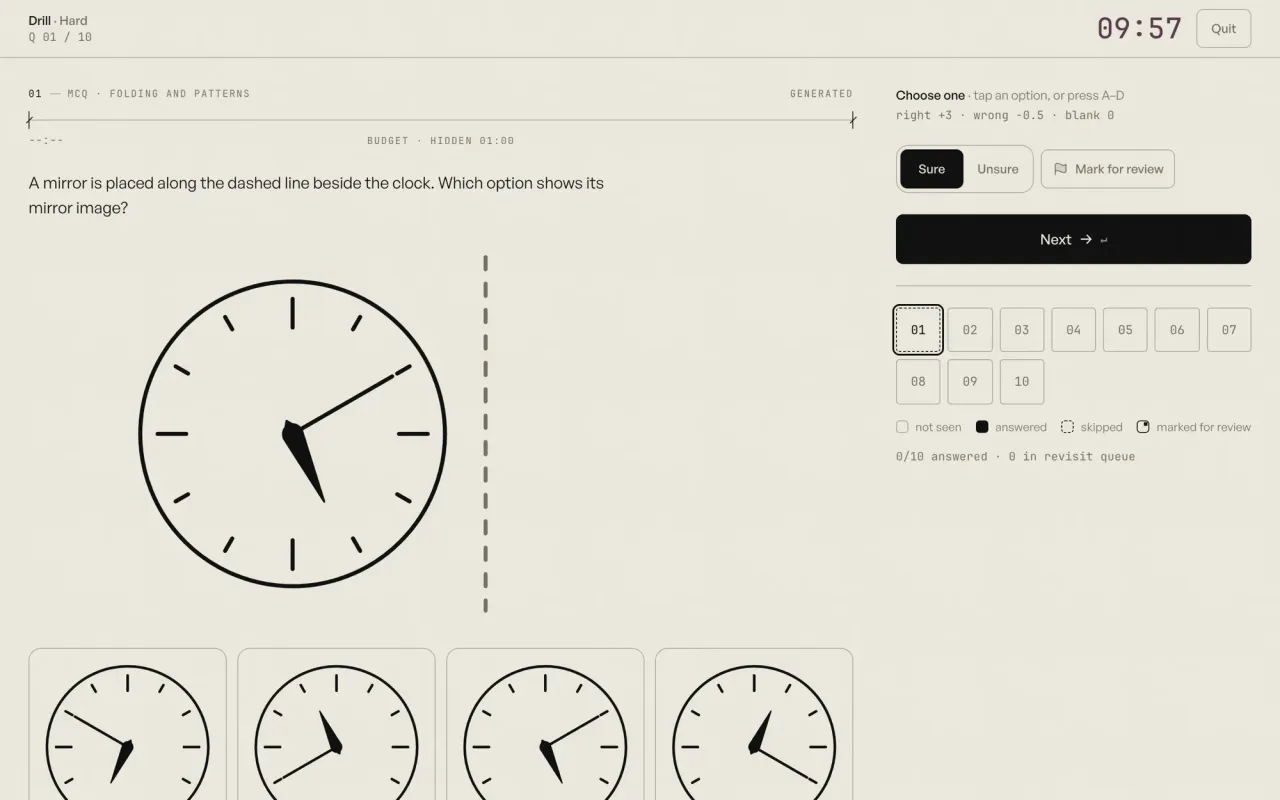
Real papers run out; visual puzzles don't have to. I built 11 generators for the types CEED repeats: paper folding, mirror images, cube nets, rotations, views of stacked cubes.
Each generator builds a puzzle forward from a seed, a random starting number; a separate solver checks it in reverse. Wrong options are near-misses (a mirror instead of a rotation, one cell off), so you have to see the answer rather than eliminate your way to it.
1,000+seeds per generator, built one way and solved the other. They agree every time.
A generated puzzle under the app's rules: the figure hides, the clock runs unseen, and a commit is final.
A square sheet of paper is folded as shown and then punched through all layers in the last step. A punch made across a folded edge opens into a single hole. Which option shows the sheet when it is fully unfolded?
8 s to look · 60 s to decide
right +3 · wrong −0.5 · blank 0
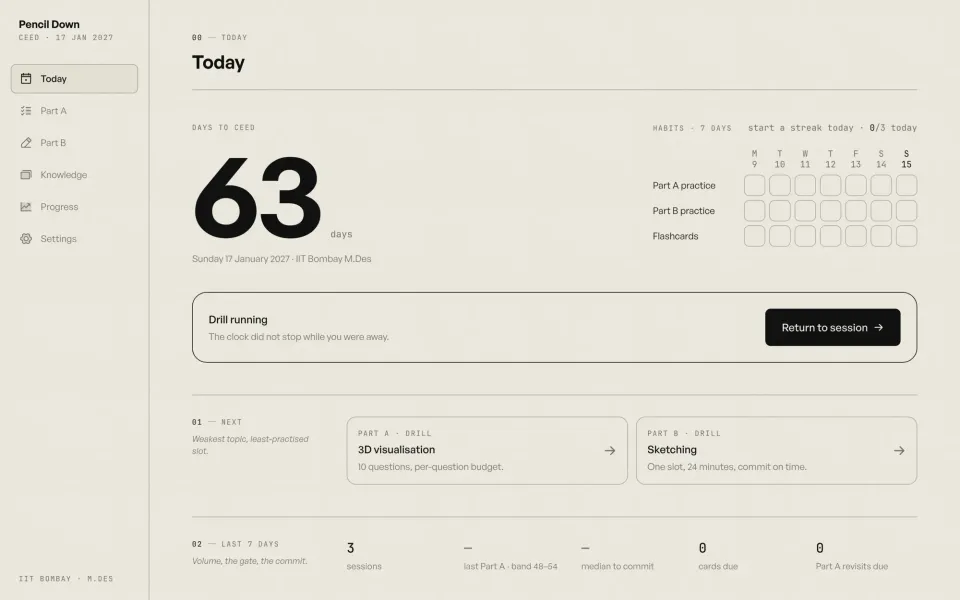
It's for one student, whose exam is on 17 January 2027, so every day spent building was a day not practising. I wrote the spec, with pass-or-fail acceptance criteria, before any code, then built in the order each step feeds the next: content, generators, app, ship, QA.
Three reports: the exam, timed thinking, every Part B prompt since 2010
Principles, modes, scoring, acceptance criteria
Deployed on push to pencil.nesh.studio, behind a login
Every criterion checked: 36 pass, 2 fixed, 1 can't pass (a 2022 prompt printed only in the answer booklet)
Each session feeds the next change: the habit tracker, 802 more worked explanations, the disputed-key review
115 real prompts from 17 CEED years, plus 312 written to the same pattern: Indian everyday settings, about one in three with a twist, banned topics checked by script.
In the app215 design-knowledge cards on spaced repetition (each returns just before you'd forget it), every sourced image with its licence recorded.
In the appMock history against the cutoff band, seconds to commit per Part B question, and a 7-day habit tracker that only shows what was done, never what was missed.
In the appOne accent per screen, one large number per screen, time drawn as a dimension line, as on a technical drawing. Checked by script on 160 screen captures, phone and laptop, light and dark.
Checked in QA