Case study2026Design engineer, DCX

DCX Atlas

A research home for Bajaj's design team. I pitched it to leadership, then designed and built it myself. Past studies now answer new questions.

2 min30 tagged insights from one study
18 → 6research types from two teams, merged into one list
6file types it reads as they are
3 teamsResearch, design and product owners use it
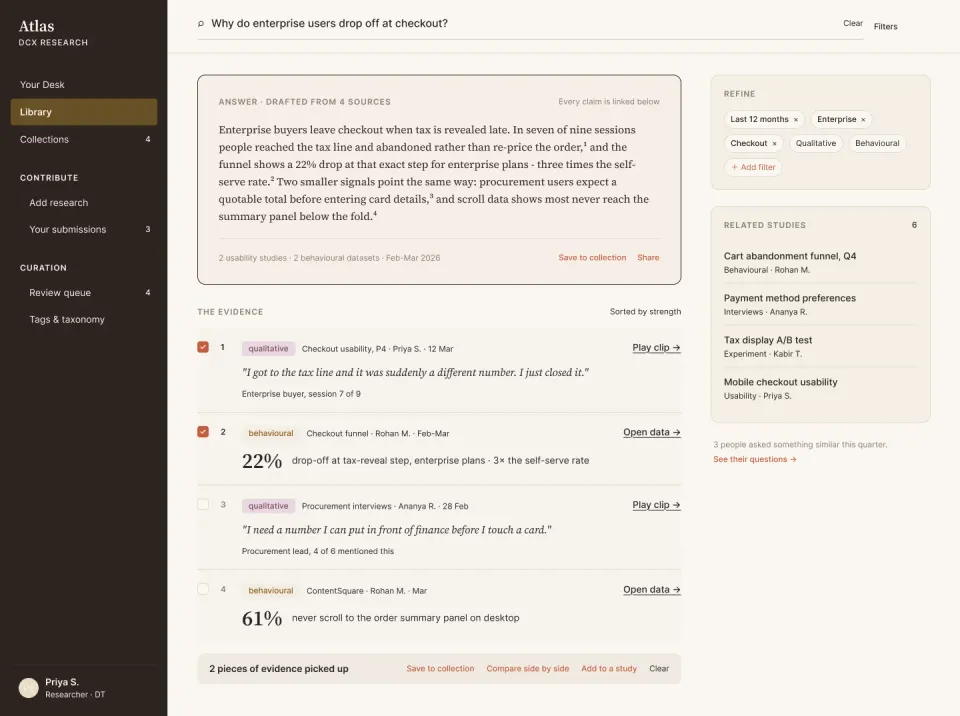
DCX Atlas answering a question: a summary drafted from four sources, each claim linked to its evidence, with the evidence sorted by strength and related studies alongside.
Every claim links to the study it came from.
01

The problem

Every study we ran died with its project.

A/B tests, surveys and interviews ended up in decks and inboxes nobody searched. The next team with the same question ran the study again, and paid for it again.

~9%of researchers say their team's research archive is mature.

So I asked leadership for the time and resources to fix it, and got them. Atlas is mine from first sketch to production.

Adding a study is a review, not data entry.

Drop a study in as it is. Atlas does the reading; you check what it found.

Live · try it

Study · writeup.docx

Sample

Loan form usability test

We tested the new personal loan form with first-time borrowers on mobile. Most moved through the first two screens without help. At the income step, several paused and asked if they needed salary slips before they could go on.A The form doesn't ask for documents there; the label only says “income”. “I closed it because I thought it would reject me for not having a payslip.”B The eligibility check felt quick. People trusted the result more when it showed the amount they qualified for, not just a yes.C Errors on the ID number field were read as blame. “It made me feel like I typed it wrong on purpose.”D Nobody used the save-and-resume link; most didn't see it.

No conversion needed
  • DOCWord
  • MDMarkdown
  • XLSExcel
  • PPTPowerPoint
  • FIGFigma link
  • TXTPasted text
Reads using
  1. The team's own wordsEvery tag, with its written definition.
  2. The team's rulesEvidence word for word. Existing tags only.
Reading the study
  1. A · AI draftUnclear income labels make people expect a document request.At the income step, several paused and asked if they needed salary slips before they could go on.
    ContentJourneysNTB
  2. B · AI draftFear of rejection makes people leave before anything is asked.I closed it because I thought it would reject me for not having a payslip.
    JourneysNTBMid-income
  3. C · AI draftShowing the eligible amount earns more trust than a plain yes.People trusted the result more when it showed the amount they qualified for, not just a yes.
    ComponentsContentNTB
  4. D · AI draftError copy on the ID field reads as blame.It made me feel like I typed it wrong on purpose.
    ContentNTBFrustrationError tone
    Frustration isn't in the vocabulary: dropped. Error tone is new: it waits for approval.
Why do first-time borrowers leave the loan form?
By meaning
By words
One list, merged by rank
  1. 12Fear of rejection, before any askB
  2. 21Income label reads as a payslip requestA
  3. 3338% leave at the income stepE
  4. 44Showing the amount builds trustC

A ranks high on both lists, so it leads the merged one. Only rank position counts.

Answer · drafted from 4 sources
Every claim is linked below

First-time borrowers stall at the income step: the label reads as a payslip request. Many leave before anything is asked, afraid of rejection, and the funnel shows it: 38% drop at that step. What keeps them is seeing the amount they qualify for, not just a yes.

1 usability study · 1 behavioural dataset · Feb–Mar
The evidence
Sorted by strength
  1. 1
    qualitativeLoan form usability · 12 Mar
    At the income step, several paused and asked if they needed salary slips.
  2. 2
    qualitativeLoan form usability · 12 Mar
    I closed it because I thought it would reject me for not having a payslip.
  3. 3
    behaviouralLoan form funnel · Feb–Mar
    38%of first-time borrowers leave at the income step
  4. 4
    qualitativeLoan form usability · 12 Mar
    People trusted the result more when it showed the amount they qualified for.

2 pieces of evidence picked

02

The system

How a study becomes something you can search.

Atlas breaks each study into insights. An insight is one observation, the quote that backs it, and 3–5 tags from a shared list (NTB, for example, means new-to-bank customers). Each one is stored twice, so a question can find it by meaning or by exact words. All of it runs on Bajaj's own servers.

One insight

ObservationError copy on the ID field reads as blame.
EvidenceIt made me feel like I typed it wrong on purpose.
TagsPersonal LoanContentNTBFrustration
Suggested tagError tone
Waits for a person to approve

Research types · 18 → 6

Design researchGenerativeEvaluativeUsability testingJourney-specific+5 more
CX analysisJourney analysisNode-to-nodeNeed-state analysisDrop-off analysis+5 more
BehaviouralConcept testingUsability testingA/B testingDrop-offJourney

Two teams kept two lists, often with different names for the same method. I merged them by method, so a study files in one place.

Closed system · Bajaj's own servers

One insight

Observation + evidenceUnclear income labels make people expect a document request.
TagsPersonal LoanContentNTB

Stored twice

Embedded as a vectorIts meaning as numbers, in 100+ languages, so a Hindi quote still matches.Found by meaning
Indexed as tags and wordsProduct, journey, segment, type: exact and filterable.Found by exact words

When someone asks

“Why do first-time borrowers leave the loan form?”
Both indexes search at once
Merged into one ranked list
The AI answers only from these, citing each one
Retrieval-augmented generation (RAG), kept closed. The AI looks up your research first and answers only from what it finds. Nothing leaves Bajaj's servers.

Trade-offs

No evidence, no insight.

Chose
A quote for every insight.
Gave up
Findings that were summarised but never sourced.
Because
Every answer is built from quotes; a finding without one has nothing to show.

A fixed tag list.

Chose
The AI can only use existing tags; new ones wait for a person to approve them.
Gave up
Tagging that grows on its own.
Because
If the AI could coin tags, two teams would drift back to two lists.
03

The answer

An answer you can check, claim by claim.

The summary sits on top, each claim numbered to its source. Below it, the evidence, strongest first. Filter chips narrow the answer and related studies widen it. Pick any evidence to save, compare or add to a study.

  1. 1
    Cited summaryEvery claim carries its source.
  2. 2
    Evidence by strengthThe strongest first, quotes and numbers alike.
  3. 3
    Filter chipsNarrow the answer.
  4. 4
    Related studiesWiden it.
  5. 5
    Pick and saveSave, compare or add to a study.

Trade-offs

Hybrid search.

Chose
Matching by meaning and by exact words, merged by rank.
Gave up
A simpler single search.
Because
Search by meaning alone fails about 4 in 10 lookups.

Say so when nothing matches.

Chose
Answering only from real results, with citations pulled from the database.
Gave up
An answer every time.
Because
One invented claim breaks trust in all of them.

After 12 months an insight is flagged as possibly out of date. It stays searchable.

04

What it grows into

AI does the grunt work. People make the calls.

Research is phase one, and it's live. Phase two adds internal data: funnels, clickstream (what people click), NPS scores and complaints. Phase three tracks competitors and the market. The goal is one system that reads all five lenses, the angles every decision is seen from: customer to regulatory.

StackNext.js, Postgres + pgvector, on Bajaj's own servers. The model that turns text into meaning runs on these servers and reads many languages, so a customer's quote stays in their language and still turns up in search.

05

Also in this work

The AI Acceleration study

I talked to the whole team, mapped the 57 activities DCX runs and timed each one: 2,130 hours a month that AI could take on. Research drafting was one of them.

Internal · Apr 2026
Research Agents

AI personas built from a 32-person study. They test designs before real users see them.

Internal · Research and testing